The Soldier
Audie Murphy before Hollywood made him a legend.
From Texas to the Third Infantry Division
Long before Hollywood placed Audie Murphy in front of a camera, war had already made him an unlikely American hero. Born into a poor sharecropping family in rural Texas in 1925, Murphy grew up with responsibilities well beyond his years. His father eventually abandoned the family, and his mother died when Murphy was still a teenager. After the United States entered World War II, he attempted to enlist despite being underage and undersized. The Marines and Navy rejected him, but the Army accepted him in 1942.¹
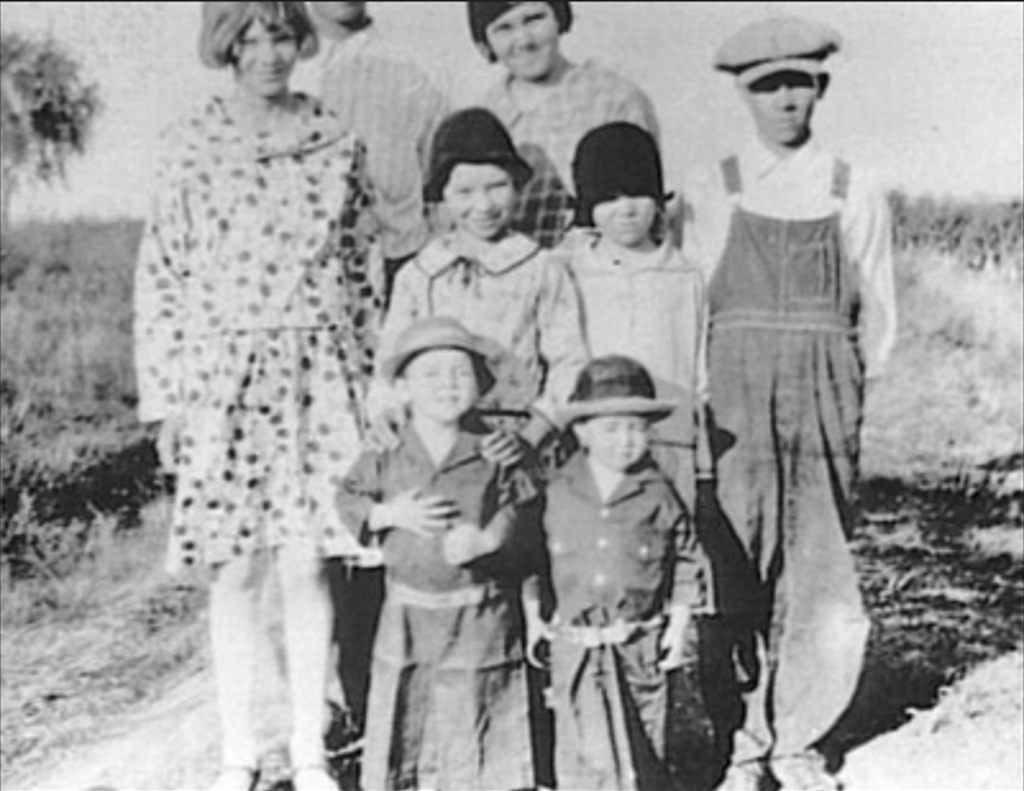
The Murphy family, circa 1930. Audie Murphy is pictured in the front row at left. Photograph reproduced by Audie L. Murphy Memorial Website.
After training, Murphy was assigned to Company B, 1st Battalion, 15th Infantry Regiment, 3rd Infantry Division. He arrived overseas in North Africa before entering combat during the invasion of Sicily in July 1943. From there, Murphy’s war followed the 3rd Infantry Division through some of the most difficult fighting of the European theater: Sicily, mainland Italy, Anzio, southern France, the Vosges Mountains, and finally into Germany.²
Murphy entered the Army as a young private, but combat steadily transformed both his responsibilities and his rank. He became a noncommissioned officer, received a battlefield commission as a second lieutenant, and repeatedly distinguished himself under fire. By the end of the war, he had been wounded multiple times and received numerous American and foreign decorations, culminating in the Medal of Honor for his actions near Holtzwihr, France, on January 26, 1945.³
That record is important to understanding To Hell and Back. Murphy was not a fictional hero created for the screen, nor was his military reputation manufactured by Universal-International. When audiences watched him reenact his wartime experiences in 1955, they were watching the actual soldier whose experiences had first been documented in military records and then recounted in his 1949 autobiography. The question for the film is not whether Audie Murphy was a hero, but what happened when Hollywood attempted to turn the experiences of that real soldier into a movie.
Footnote sources:
- David A. Smith, The Price of Valor; Audie Murphy, To Hell and Back.
- Donald G. Taggart, ed., History of the Third Infantry Division in World War II; Murphy, To Hell and Back.
- Murphy’s Medal of Honor citation and supporting military documentation.
A Record of Valor
Murphy’s military record culminated in the Medal of Honor for his actions near Holtzwihr, France, on January 26, 1945. His official citation provides a contemporary military account of the action that would later become one of the central episodes portrayed in To Hell and Back.
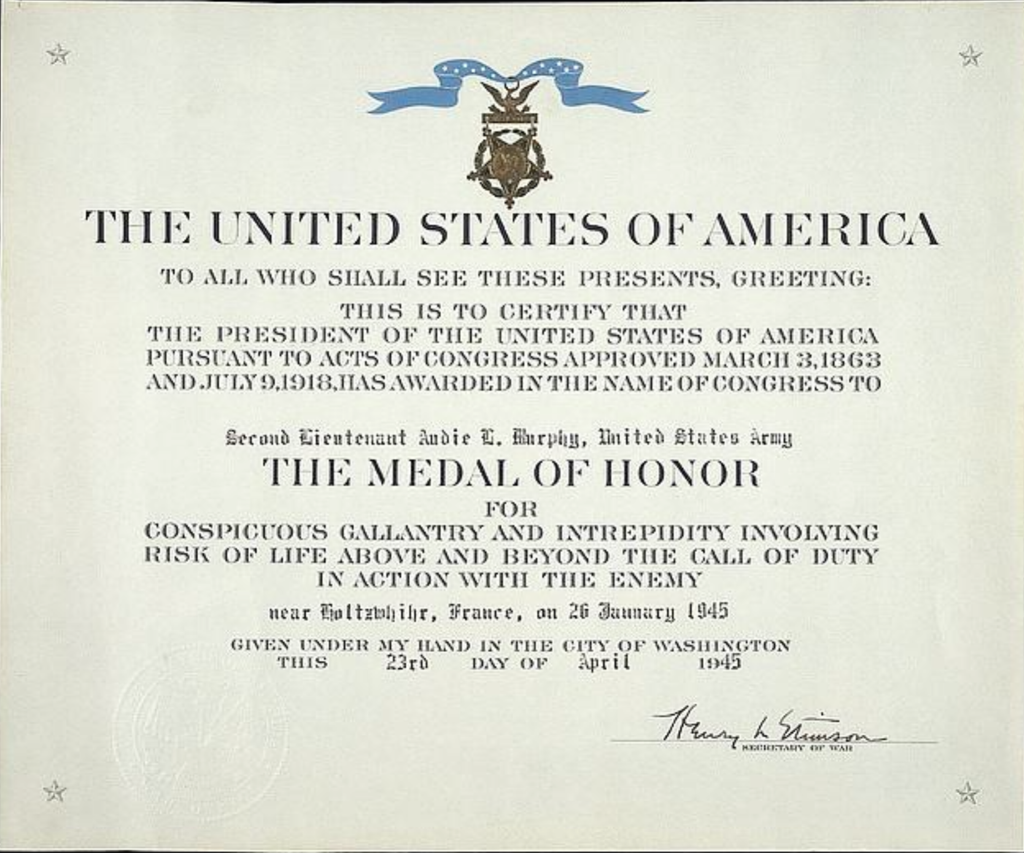
Source: “Audie L. Murphy Medal of Honor Citation,” 1945, National Museum of American History, Smithsonian Institution.
Holtzwihr, January 26, 1945
On January 26, 1945, near Holtzwihr, France, Murphy’s company came under attack by German infantry supported by tanks. After ordering his men to withdraw, Murphy remained behind and directed artillery fire against the advancing Germans. He then climbed onto a burning tank destroyer and used its .50-caliber machine gun against the enemy while continuing to call in artillery fire. Wounded and exposed to enemy fire, Murphy held his position until his ammunition was exhausted, then returned to his company and helped organize a counterattack. The action earned him the Medal of Honor and later provided one of the most recognizable scenes in To Hell and Back.
More Than the Medal of Honor
The Medal of Honor was the highest recognition of Murphy’s wartime service, but it represented only one part of an extraordinary combat record. During his service, Murphy also received the Distinguished Service Cross, two Silver Stars, the Legion of Merit, two Bronze Stars, and three Purple Hearts, along with numerous campaign, unit, and foreign decorations. His European-African-Middle Eastern Campaign Medal represented participation in eight campaigns, from Tunisia through Central Europe. By the end of the war, Murphy had progressed from an enlisted infantryman to a commissioned officer and had become one of the most highly decorated American soldiers of World War II.¹
The number of decorations, however, can obscure the experiences behind them. Murphy’s awards represented repeated exposure to combat, wounds, the deaths of fellow soldiers, and increasing responsibility as casualties reduced the ranks of experienced infantrymen. His wartime record was therefore more than a collection of medals. It documented nearly two years of combat that would later provide the foundation for his memoir and, ultimately, To Hell and Back.
That distinction matters when approaching the 1955 film. Hollywood did not create Audie Murphy’s heroism, but it did decide how that heroism would be remembered on screen.
- Audie Murphy Research Foundation, “Military Decorations of Audie Murphy,” Audie L. Murphy Memorial Website, last updated June 23, 2020.